

Walk through any grocery store, pharmacy, or warehouse, and you’ll encounter products made possible by one of the polymer industry’s most versatile manufacturing methods: cast extrusion. From food packaging and medical films to industrial liners and specialty materials, cast extrusion has become an indispensable process for producing high-quality plastic films with exceptional consistency and performance.
The Cast Extrusion Process
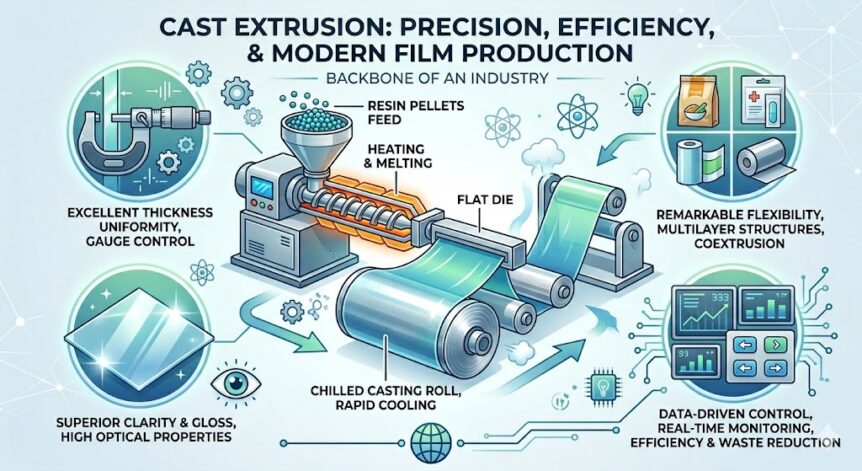
At its core, cast extrusion is a relatively straightforward process. Polymer resin pellets are fed into an extruder, where they are heated and melted. The molten polymer is then pushed through a flat die, forming a thin sheet of material that is immediately deposited onto a chilled casting roll. Rapid cooling solidifies the film before it is further processed through a series of rollers for trimming, surface treatment, winding, or additional converting operations.
The Advantages of Cast Extrution
While the concept may seem simple, the advantages of cast extrusion are significant.
One of the process’s greatest strengths is its ability to produce films with excellent thickness uniformity. Because the molten polymer is rapidly cooled on polished chill rolls, manufacturers can achieve tight gauge tolerances and highly consistent optical properties. This level of control is particularly important in applications such as food packaging, where appearance, sealing performance, and barrier characteristics directly influence product quality and shelf life.
Cast extrusion also offers remarkable flexibility. A wide range of polymers—including polyethylene, polypropylene, polyethylene terephthalate, and specialized multilayer structures—can be processed using cast technology. Coextrusion systems further expand these capabilities by allowing multiple polymer layers to be combined into a single film, with each layer contributing specific functional properties such as sealability, stiffness, puncture resistance, or oxygen barrier performance.
Compared with blown film processes, cast extrusion generally allows for higher production speeds and superior clarity. The rapid quenching process minimizes crystallization in certain polymers, resulting in films with outstanding transparency and gloss. These characteristics make cast films particularly attractive for consumer packaging applications where visual appeal matters.
Cast Extrusion Trade-offs
Of course, every manufacturing process involves trade-offs. Cast films may exhibit different mechanical properties than blown films, especially in terms of directional strength and tear resistance. Equipment costs can also be substantial, particularly for sophisticated multilayer lines equipped with advanced control systems. As manufacturers evaluate production methods, understanding the relationship between process conditions and end-use requirements becomes critical.
Today’s cast extrusion operations increasingly rely on automation and data-driven process control. Modern systems monitor variables such as melt temperature, die pressure, line speed, and film thickness in real time, enabling operators to make precise adjustments that reduce waste and improve efficiency. As sustainability initiatives continue to reshape the plastics industry, these advancements are helping manufacturers maximize material utilization while maintaining demanding quality standards.
The Future of Cast Extrusion
The future of cast extrusion is closely tied to broader trends within polymer processing. Lightweight packaging, recyclable mono-material structures, downgauging strategies, and increased incorporation of recycled content are all influencing how cast films are designed and produced. Equipment manufacturers and material scientists are collaborating to develop solutions that meet both performance expectations and evolving environmental goals.
Although consumers rarely think about how the films surrounding their products are made, cast extrusion quietly supports countless aspects of modern life. Its combination of precision, speed, versatility, and adaptability has secured its place as one of the most important technologies in polymer processing.
As the industry continues to innovate, cast extrusion will remain at the forefront—transforming resin into the films that protect products, preserve resources, and connect advanced materials science with everyday applications.
